
Attic ventilation in Houston homes traps heat that raises cooling costs and shortens roof life. Attics can reach 140 to 160°F in summer. Schedule a free attic ventilation inspection and find out what is causing the problem.
Hands-on attic assessment. Written report sent to you immediately. Yours to keep.
Prefer to call? 832-246-9931 · 7am–10pm, 7 days


 Trustindex verifies that the original source of the review is Google.
 Trustindex verifies that the original source of the review is Google.
 Trustindex verifies that the original source of the review is Google.
 Trustindex verifies that the original source of the review is Google.
 Trustindex verifies that the original source of the review is Google.
 Trustindex verifies that the original source of the review is Google.
 Trustindex verifies that the original source of the review is Google.
 Trustindex verifies that the original source of the review is Google.
 Trustindex verifies that the original source of the review is Google.
 Trustindex verifies that the original source of the review is Google.
Most Houston homeowners think of their attic as storage space. From a roof system standpoint, it is something different.
The attic is the airflow chamber that affects how long your shingles last, how hard your AC has to work, and whether your upstairs ever feels cool in August.
When that system is balanced, the roof above it can last 22 to 25 years in Houston conditions. When it is not balanced, the same roof can fail in 13 to 17 years even with high-quality shingles, because the heat trapped underneath cooks the asphalt from the back side.
Many Houston-area homes with shorter-than-expected shingle life have a roof ventilation problem, not a shingle problem. Roof ventilation in Houston is one of the details that decides how long a roof lasts.
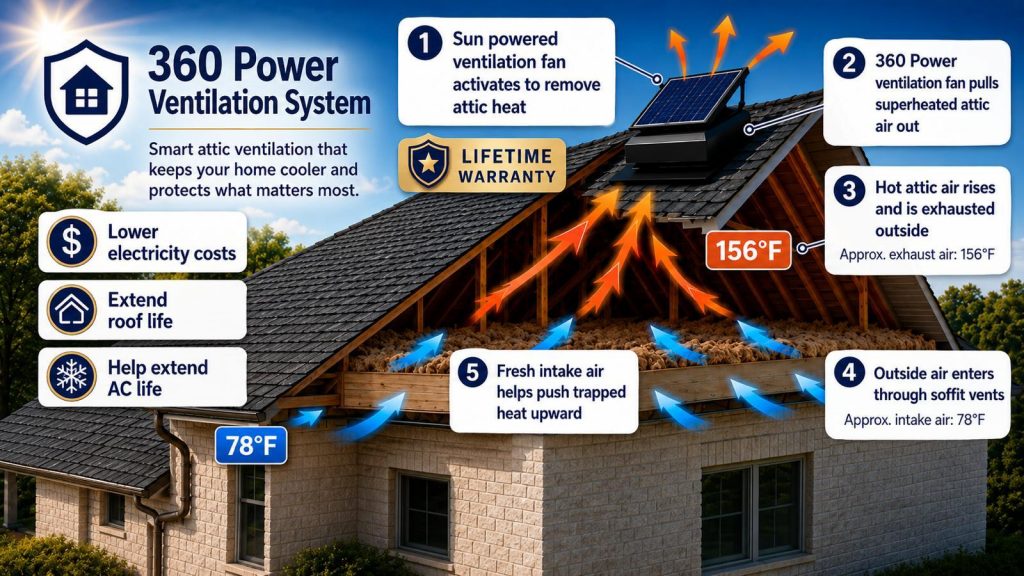
Houston has long stretches of 90-degree days from June through September, and attic temperatures regularly reach 140 to 160 degrees by mid-afternoon. Heat at that level degrades shingle adhesives, dries out underlayment, and speeds up UV breakdown from underneath.
Humid air that gets into the attic in summer condenses on cooler surfaces such as rafters and decking, and creates moisture problems. Without proper exhaust, moisture sits in the attic and slowly damages decking and structural wood.
Storm damage to ridge vents, soffit vents, and roof penetrations often goes unnoticed until summer, when the attic stops breathing properly. Most homeowners do not check ventilation after a storm. If a vent is damaged, our roof repair work covers it.
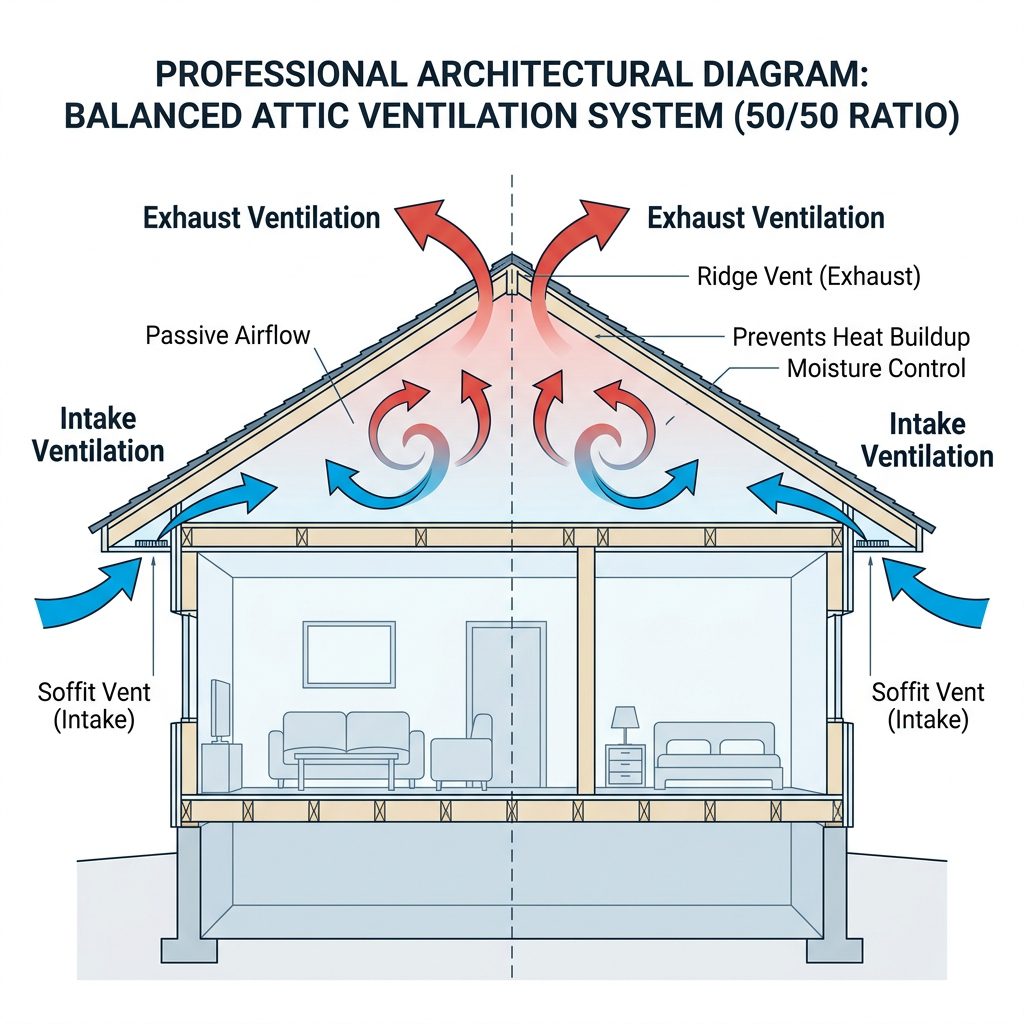
People talk about “attic ventilation” all the time, but most do not know what it is. Good Houston roof ventilation has two halves, and both have to work together.
Intake vents bring fresh outside air into the attic. The most common intake vents in Houston homes are soffit vents along the underside of the eaves. Some homes use gable vents or edge vents instead. The intake side is what most homeowners forget to check, because soffit vents are hidden under the eaves and often clogged with paint, debris, or insulation.
Exhaust vents allow trapped heat and moisture to escape the attic. Depending on the home, the right solution may include ridge vents, roof vents, or solar attic fans.
We evaluate the roof, attic, intake airflow, and existing ventilation before recommending the right solution.
A common guideline is about 1 square foot of net free vent area for every 150 square feet of attic floor, split roughly evenly between intake and exhaust. Some attics qualify for a lower ratio. We calculate yours during the inspection.
Most Houston homeowners do not connect a hot upstairs, rising cooling bills, and short shingle life. They are often symptoms of the same problem.
A poorly ventilated attic transfers heat through the ceiling into your living space all summer. Your AC works harder to fight that heat load. Studies of Texas homes have shown summer cooling bills 15 to 25% higher in homes with poor attic ventilation compared to homes with balanced systems. On a $300 monthly summer cooling bill, that is $45 to $75 every month, repeated across 4 to 5 summer months per year.
Shingles fail from the top down (UV, weather) and from the bottom up (attic heat). Most homeowners only think about the top. Bottom-up heat damage from a very hot attic can shorten shingle life by several years, which is real money on a new roof.
HVAC systems sized for normal heat loads run harder, longer, and break down sooner when they are fighting an unbalanced attic. Compressor replacements, blower motor failures, and capacitor failures all happen more frequently in homes with poor ventilation.
Trapped humidity condenses on decking and rafters and slowly damages the wood. Long-term attic moisture damage is expensive to fix because it is usually found late.
A poorly ventilated attic makes upstairs bedrooms hot in summer no matter how big your AC is. Many homeowners adapt by running fans or avoiding the second floor in the afternoon. None of that fixes the cause.
We offer solar attic fan installation as part of our attic ventilation services in Houston. A solar fan pulls hot air out of the attic and costs nothing to run, but it works well only when the attic has enough intake ventilation.
Before recommending one, we evaluate attic size, intake airflow, existing vents, and roof design. That tells us the right solution for your home, whether it is a solar attic fan, a ridge vent, or a combination.
Six steps from first contact to verified, warranted results.
We physically enter the attic and walk every accessible space. We check current intake vent locations, exhaust vent placement, insulation condition, and signs of heat or moisture damage. We climb the roof to check exterior ventilation hardware. Documentation includes photos and video of every finding.
We measure the attic’s available intake and exhaust ventilation.
We then identify insufficient airflow, blocked intake, or ventilation systems that may not be working properly together.
You receive a written assessment in plain English explaining what we found, what the system is doing wrong (if anything), and what would need to change to balance it. If the system is already balanced and functioning correctly, we tell you it is. We do not recommend work that is not needed.
Every home is different.
Depending on what we find, we may recommend additional intake ventilation, ridge ventilation, solar attic fans, or corrections to the existing system.
Most attic ventilation work can be completed in a single day. Some larger jobs (full ridge vent retrofits, major soffit additions) run 2 to 3 days. We document the completed work with photos.
After installation, we verify airflow performance and document the corrected balance. Workmanship warranty applies to all ventilation work, same as our roofing work.
Attic ventilation work can be done on its own or as part of a roof replacement in Houston. Knowing which makes sense saves time and money.
The cost case: Standalone ventilation rebuilds typically cost $1,500 to $4,500 depending on scope. When done as part of a roof replacement, the incremental cost is much lower because the labor is already there. A homeowner who waits 2 years for a planned roof replacement and combines the ventilation rebuild often pays significantly less total than doing them separately. We give you the honest math during the inspection.
Standalone attic ventilation rebuilds in Houston typically cost $1,500 to $4,500, depending on scope, attic size, and the condition of the current vents. Adding ventilation as part of a roof replacement costs much less extra because the labor is already there.
Common signs are upstairs rooms that stay warm while the AC runs hard, cooling bills that keep climbing, shingles failing in spots, heat damage on attic decking, and condensation or mold in the attic. A hands-on attic inspection confirms the cause.
It can. Cutting attic heat reduces the heat load on your ceiling and your AC. Results vary by home, so we don’t promise a number. Our written assessment tells you what is likely to help.
It depends on scope. Small fixes, like clearing blocked soffits or adding a vent, can be done in one visit. A full redesign takes longer. Your written assessment gives you the timeline.
If your roof has 5+ years of life remaining and you are not planning a replacement in the next 2 to 3 years, standalone rebuild is usually right. If your roof is over 18 to 20 years old or already on the replacement schedule, combining the two is usually more cost-effective.
Ridge vents run along the peak and let hot air escape quietly, with no moving parts. Turbine vents spin with the wind and can be less consistent. Mixing exhaust types can make them compete with each other. We choose based on your attic.
Yes. Most Houston attic ventilation problems can be addressed without a full roof replacement, particularly when the issue is insufficient intake ventilation (soffit work) or clogged exhaust vents. Major ridge vent retrofits sometimes require opening the roof slightly, but full replacement is rarely necessary just for ventilation.
Sometimes. If a covered storm damaged your vents, repairs may be part of the claim. Upgrades on their own are usually not covered. When insurance pays for a roof replacement, some ventilation work may be included. We are not public adjusters, so check coverage with your carrier.
Attic ventilation does not heat or cool your living space directly. In Houston’s mild winters the effect is minimal, and balanced airflow helps clear moisture from the attic.
Trustindex verifies that the original source of the review is Google. Trustindex verifies that the original source of the review is Google. Trustindex verifies that the original source of the review is Google. Trustindex verifies that the original source of the review is Google. Trustindex verifies that the original source of the review is Google. Trustindex verifies that the original source of the review is Google. Trustindex verifies that the original source of the review is Google. Trustindex verifies that the original source of the review is Google. Trustindex verifies that the original source of the review is Google. Trustindex verifies that the original source of the review is Google. Free hands-on attic ventilation assessment. Written report sent to you immediately.
If your upstairs runs hot in summer, your cooling bills are climbing, or your shingles seem to be aging faster than they should, the problem is usually attic ventilation. We assess the system, identify what is working and what is not, and give you a written recommendation in plain English. Start with a free roof inspection in Houston, TX and we will check your attic ventilation at the same time.