Houston attics can reach 140–160°F, trapping heat that increases cooling costs and shortens roof life. Schedule a free attic ventilation inspection and find out what’s causing the problem.
Hands-on attic assessment. Written report sent to you immediately. Yours to keep.
Prefer to call? 832-246-9931 · 7am–10pm, 7 days
Posted on Google
 Christian Shafer
Trustindex verifies that the original source of the review is Google.
This is the third time we’re using 360power Roofing for our roofing projects. They never disappointed each time. From roof repairs to roof replacements in our rental properties. They cleaned up well and are always responsive and ready to help. Keep up the good job guys. Highly recommended .Posted on Google Mark Frazier10/10 !! What an amazing team! they got here at 6:30 in the morning for my roof replacement here in the woodlands. Alex was very professional and knowledgeable. The solar fan they installed has made a significant difference!! our upstairs no longer stay hot and our electricity bill significantly dropped!! we are so pleased and will gladly recommend this team to anyone looking for a roof repair or roof replacement .Posted on Google
 Ivan Turro HernándezI am highly impressed with the quality of work Alex and the team did, from the first consultation to cleaning up, they did an amazing job. Highly recommend 360 power roofing for anyone who in spring tx looking to replace their roof.. 10/10Posted on Google
 Monique AllenMy husband and l got several different quotes from other companies but the details and knowledge the rep showed in explaining everything that they were going to do and the materials was exceptional. He answered all our questions and more. This was a roof replacement for our rental home in the Woodlands. We will be definitely using 360power roofing for our main house when the time comes. I strongly recommend anyone who wants a roof replacement done.Posted on Google
 Cary SakalysAmazing service! They are super thorough and informative! I highly recommend them to anyone who is looking for roof repair.Posted on Google
 Luis MoyaAlex was so knowledgeable, from the first consultation, he was on time, he was very detailed and answered all the questions we had. The installation was done in one day and the color he helped us pick out looks great with the color of the house. They also installed a solar attic fan for us which has helped cool our house down significantly and our electricity bills dropped significantly. I will gladly recommend Alex and the 360power Roofing team for anyone who is interested in getting a new roof or getting ventilation for their homes. Thanks once again for the awesome job.Posted on Google
 Denise “Denise” TThe technician was very professional and helpful. He helped us with the repair we need. I will recommend this company.Posted on Google
 Jessica Soriano360Power Roofing did an outstanding roof replacement in Spring, Texas. We compared multiple roofing companies in the Houston area, and they stood out for professionalism, quality workmanship, and attention to detail. They helped us choose the perfect roof color and significantly improved our attic ventilation, which has already helped with high energy bills. Highly recommend 360Power Roofing for anyone needing reliable roofing services in Spring or Houston, TX.Posted on Google
 Melissa AyaoThey got here very early in the morning and were done before 3pm. They cleaned up thoroughly and left my yard looking like nothing happened. From the initial inspection, James was so professional and very detailed, he even pointed out how poor ventilation affected our roof .He answered all our questions and more. The project manager was amazing(l forgot his name) l would highly recommend 360power roofing to anyone who’s looking for looking for a new roof or roof ventilation. They are awesome, honest and knowledgeable. 5star for them!!Posted on Google
 Kairna FernandezI can’t say enough great things about 360Power Roofing. As a homeowner in Houston, getting my roof replaced felt overwhelming at first, I had no prior experience and knew it was a major investment. I took the time to get multiple quotes, but 360Power Roofing stood out immediately. Their team was knowledgeable, transparent, and took the time to explain everything in a way I could actually understand, no pressure, just honest guidance that made me feel confident in my decision. A special shoutout to Mario for his professionalism and attention to detail. He was responsive, respectful, and made sure the entire process ran smoothly from start to finish. They replaced my roof and installed a new ventilation system, and the quality of the work is outstanding. The crew showed up on time, worked efficiently, and kept the area clean throughout the project, which I really appreciated. Overall, this was a seamless and stress-free experience. My home looks amazing, and I have peace of mind knowing everything was done right. If you’re in the Houston area and need roofing services, I highly recommend 360Power Roofing. I would absolutely use them again and refer them to anyone looking for quality work and exceptional customer service.
Most Houston homeowners think of their attic as storage space. From a roof system standpoint, it is something different.
The attic is the airflow chamber that determines how long your shingles last, how hard your AC has to work, and whether your upstairs ever feels cool in August.
When that system is balanced, the roof above it can last 22 to 25 years in Houston conditions. When it is not balanced, the same roof can fail in 13 to 17 years even with high-quality shingles, because the heat trapped underneath cooks the asphalt from the back side.
Most Houston-area homes with shorter-than-expected shingle life have an attic ventilation problem, not a shingle problem.
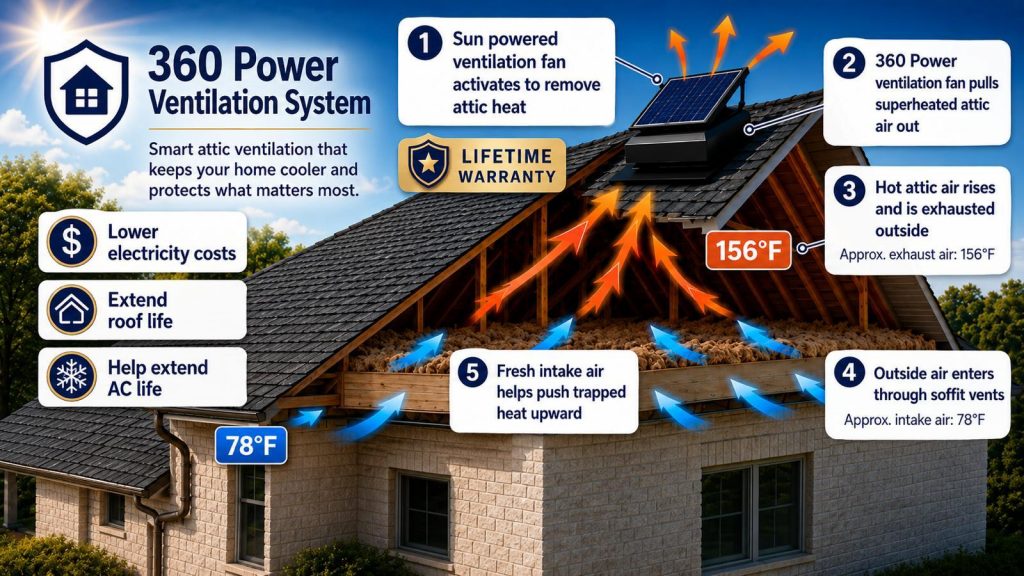
Houston averages 90+ degree days from June through September, with attic temperatures regularly hitting 140 to 160 degrees by mid-afternoon. Trapped heat at those temperatures degrades shingle adhesives, dries out underlayment, and accelerates UV breakdown from underneath.
Humidity that gets into the attic during summer condenses against cooler surfaces (rafters, decking, insulation) and creates moisture problems. Without proper exhaust, moisture sits in the attic and slowly damages decking and structural wood.
Storm-related damage to ridge vents, soffit vents, and roof penetrations often goes unnoticed until summer arrives and the attic stops breathing properly. Most homeowners do not check ventilation after storm events.
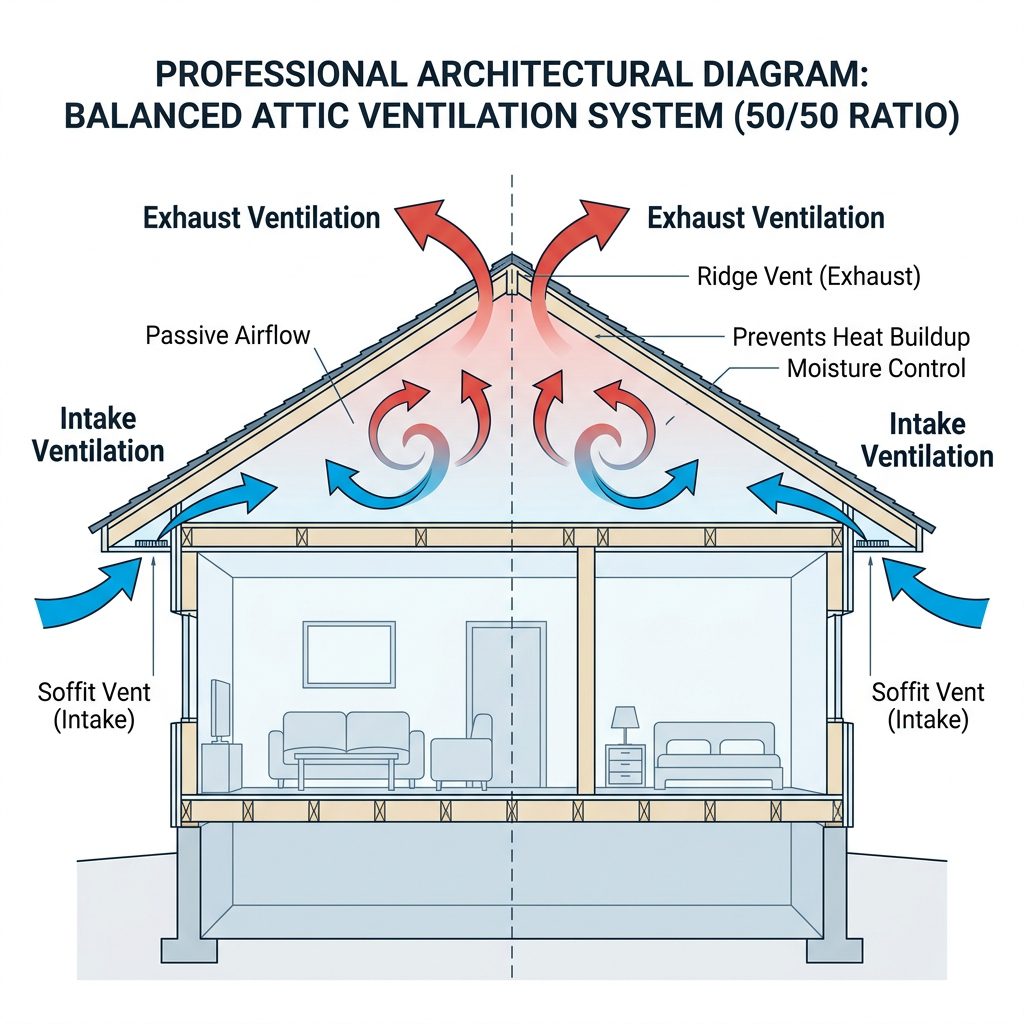
The phrase “attic ventilation” gets thrown around a lot. Most homeowners do not know what it actually is. The system has two halves, and both halves have to work together.
Intake vents bring fresh outside air into the attic. The most common intake vents in Houston homes are soffit vents along the underside of the eaves. Some homes use gable vents or edge vents instead. The intake side is what most homeowners forget to check, because soffit vents are hidden under the eaves and often clogged with paint, debris, or insulation.
Exhaust vents allow trapped heat and moisture to escape the attic. Depending on the home, the right solution may include ridge vents, roof vents, or solar attic fans.
We evaluate the roof, attic, intake airflow, and existing ventilation before recommending the right solution.
Good attic ventilation requires intake and exhaust to work together.
We evaluate both sides of the system and identify areas where airflow is restricted or unbalanced.
Most Houston homeowners do not connect their hot upstairs, rising cooling bills, and short shingle life to a single underlying cause. They are usually all symptoms of the same problem.
A poorly ventilated attic transfers heat through the ceiling into your living space all summer. Your AC works harder to fight that heat load. Studies of Texas homes have shown summer cooling bills 15 to 25% higher in homes with poor attic ventilation compared to homes with balanced systems. On a $300 monthly summer cooling bill, that is $45 to $75 every month, repeated across 4 to 5 summer months per year.
Asphalt shingles fail from the top down (UV, weather) and from the bottom up (attic heat). Most homeowners only think about top-down failure. Bottom-up failure from a 150-degree attic can shorten shingle life by 3 to 7 years. On a $15,000 roof, losing 5 years of life is roughly $3,000 to $4,000 in accelerated depreciation.
HVAC systems sized for normal heat loads run harder, longer, and break down sooner when they are fighting an unbalanced attic. Compressor replacements, blower motor failures, and capacitor failures all happen more frequently in homes with poor ventilation.
Trapped humidity condenses on decking, rafters, and insulation, slowly damaging the structural wood and reducing insulation effectiveness. Long-term moisture damage in the attic is one of the most expensive home repairs to fix because it is usually discovered late.
A poorly ventilated attic makes upstairs bedrooms hot in summer regardless of AC capacity. Most homeowners with this problem have adapted by running fans, keeping doors closed, or just avoiding the second floor in the afternoon. None of those are real fixes.
We install solar attic fans as part of our attic ventilation services.
Before recommending one, we evaluate attic size, intake airflow, existing vents, and roof design.
This helps us determine the right ventilation solution for the home.
Six steps from first contact to verified, warranted results.
We physically enter the attic and walk every accessible space. We check current intake vent locations, exhaust vent placement, insulation condition, and signs of heat or moisture damage. We climb the roof to check exterior ventilation hardware. Documentation includes photos and video of every finding.
We measure the attic’s available intake and exhaust ventilation.
We then identify insufficient airflow, blocked intake, or ventilation systems that may not be working properly together.
You receive a written assessment in plain English explaining what we found, what the system is doing wrong (if anything), and what would need to change to balance it. If the system is already balanced and functioning correctly, we tell you it is. We do not recommend work that is not needed.
Every home is different.
Depending on what we find, we may recommend additional intake ventilation, ridge ventilation, solar attic fans, or corrections to the existing system.
Most attic ventilation work can be completed in a single day. Some larger jobs (full ridge vent retrofits, major soffit additions) run 2 to 3 days. We document the completed work with photos.
After installation, we verify airflow performance and document the corrected balance. Workmanship warranty applies to all ventilation work, same as our roofing work.
Attic ventilation work can be done as a standalone service or as part of a roof replacement. Knowing which makes sense for your situation saves time and money.
The cost case: Standalone ventilation rebuilds typically cost $1,500 to $4,500 depending on scope. When done as part of a roof replacement, the incremental cost is much lower because the labor is already there. A homeowner who waits 2 years for a planned roof replacement and combines the ventilation rebuild often pays significantly less total than doing them separately. We give you the honest math during the inspection.
Standalone attic ventilation rebuilds in Houston typically cost $1,500 to $4,500 depending on scope, attic size, and current vent condition. Adding ventilation as part of a roof replacement adds significantly less cost because the labor is already there.
Common signs include upstairs rooms that stay hot even with the AC running, summer cooling bills climbing year over year, shingles failing earlier than expected, visible heat damage on attic decking, and condensation or mold on attic surfaces. Our free inspection includes an attic ventilation assessment.
Yes, for most Houston homes. Studies show summer cooling bills can be 15 to 25% lower in homes with balanced attic ventilation compared to homes with poor ventilation. The actual savings depend on attic size, current system condition, and AC efficiency.
Most standalone attic ventilation rebuilds are completed in a single day. Larger jobs involving major soffit additions or full ridge vent retrofits run 2 to 3 days.
If your roof has 5+ years of life remaining and you are not planning a replacement in the next 2 to 3 years, standalone rebuild is usually right. If your roof is over 18 to 20 years old or already on the replacement schedule, combining the two is usually more cost-effective.
Ridge vents run along the peak of the roof and exhaust hot air through a continuous opening. Turbine vents are spinning metal exhaust caps that pull air out using wind energy. Ridge vents typically outperform turbines in Houston because they move air more consistently and have no moving parts to fail.
Yes. Most Houston attic ventilation problems can be addressed without a full roof replacement, particularly when the issue is insufficient intake ventilation (soffit work) or clogged exhaust vents. Major ridge vent retrofits sometimes require opening the roof slightly, but full replacement is rarely necessary just for ventilation.
Standalone ventilation rebuilds are typically not covered by homeowners insurance because they fall under maintenance and upgrade work rather than damage repair. Ventilation work can sometimes be included in an approved storm damage scope when the original ventilation was damaged by the storm event.
Properly balanced ventilation does not significantly impact winter heating because the attic is already a separate thermal zone from the living space. Insulation between your ceiling and attic floor is what controls winter heat retention. Ventilation controls summer heat and moisture, which are the bigger issues in Houston year-round.
Posted on GoogleChristian ShaferThis is the third time we’re using 360power Roofing for our roofing projects. They never disappointed each time. From roof repairs to roof replacements in our rental properties. They cleaned up well and are always responsive and ready to help. Keep up the good job guys. Highly recommended .Posted on GoogleMark Frazier10/10 !! What an amazing team! they got here at 6:30 in the morning for my roof replacement here in the woodlands. Alex was very professional and knowledgeable. The solar fan they installed has made a significant difference!! our upstairs no longer stay hot and our electricity bill significantly dropped!! we are so pleased and will gladly recommend this team to anyone looking for a roof repair or roof replacement .Posted on GoogleIvan Turro HernándezI am highly impressed with the quality of work Alex and the team did, from the first consultation to cleaning up, they did an amazing job. Highly recommend 360 power roofing for anyone who in spring tx looking to replace their roof.. 10/10Posted on GoogleMonique AllenMy husband and l got several different quotes from other companies but the details and knowledge the rep showed in explaining everything that they were going to do and the materials was exceptional. He answered all our questions and more. This was a roof replacement for our rental home in the Woodlands. We will be definitely using 360power roofing for our main house when the time comes. I strongly recommend anyone who wants a roof replacement done.Posted on GoogleCary SakalysAmazing service! They are super thorough and informative! I highly recommend them to anyone who is looking for roof repair.Posted on GoogleLuis MoyaAlex was so knowledgeable, from the first consultation, he was on time, he was very detailed and answered all the questions we had. The installation was done in one day and the color he helped us pick out looks great with the color of the house. They also installed a solar attic fan for us which has helped cool our house down significantly and our electricity bills dropped significantly. I will gladly recommend Alex and the 360power Roofing team for anyone who is interested in getting a new roof or getting ventilation for their homes. Thanks once again for the awesome job.Posted on GoogleDenise “Denise” TThe technician was very professional and helpful. He helped us with the repair we need. I will recommend this company.Posted on GoogleJessica Soriano360Power Roofing did an outstanding roof replacement in Spring, Texas. We compared multiple roofing companies in the Houston area, and they stood out for professionalism, quality workmanship, and attention to detail. They helped us choose the perfect roof color and significantly improved our attic ventilation, which has already helped with high energy bills. Highly recommend 360Power Roofing for anyone needing reliable roofing services in Spring or Houston, TX.Posted on GoogleMelissa AyaoThey got here very early in the morning and were done before 3pm. They cleaned up thoroughly and left my yard looking like nothing happened. From the initial inspection, James was so professional and very detailed, he even pointed out how poor ventilation affected our roof .He answered all our questions and more. The project manager was amazing(l forgot his name) l would highly recommend 360power roofing to anyone who’s looking for looking for a new roof or roof ventilation. They are awesome, honest and knowledgeable. 5star for them!!Posted on GoogleKairna FernandezI can’t say enough great things about 360Power Roofing. As a homeowner in Houston, getting my roof replaced felt overwhelming at first, I had no prior experience and knew it was a major investment. I took the time to get multiple quotes, but 360Power Roofing stood out immediately. Their team was knowledgeable, transparent, and took the time to explain everything in a way I could actually understand, no pressure, just honest guidance that made me feel confident in my decision. A special shoutout to Mario for his professionalism and attention to detail. He was responsive, respectful, and made sure the entire process ran smoothly from start to finish. They replaced my roof and installed a new ventilation system, and the quality of the work is outstanding. The crew showed up on time, worked efficiently, and kept the area clean throughout the project, which I really appreciated. Overall, this was a seamless and stress-free experience. My home looks amazing, and I have peace of mind knowing everything was done right. If you’re in the Houston area and need roofing services, I highly recommend 360Power Roofing. I would absolutely use them again and refer them to anyone looking for quality work and exceptional customer service.
Free hands-on attic ventilation assessment. Written report sent to you immediately.
If your upstairs runs hot in summer, your cooling bills are climbing, or your shingles seem to be aging faster than they should, the problem is usually attic ventilation. We assess the system, identify what is working and what is not, and give you a written recommendation in plain English.